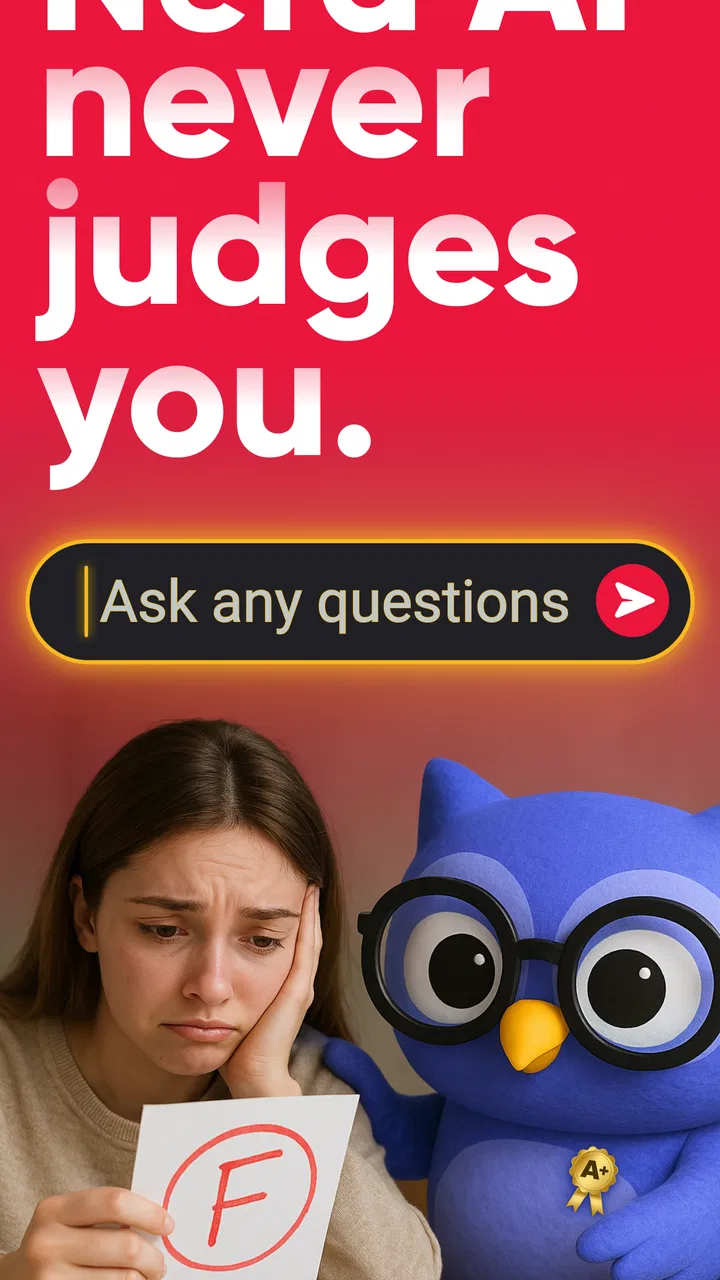
Nerd AI - Tutor & Math Helper
- 4.6
- Rating
- 10.00M
- Installs
- Free
- Price

 Analysis by App-foxy
I approached Nerd AI - Tutor & Math Helper as a study companion rather than a replacement for a teacher. That distinction matters. An AI tutor can be useful when I am stuck, short on time, or unsure how to begin, but it still needs to be treated as a tool whose explanations deserve checking. In my experience, this app is most appealing to learners who want quick help with school subjects and prefer asking questions in ordinary language instead of searching through several websites.
Deep Flow Apps places it in the education category, and the app is free to install for everyone. It has built a substantial audience, with an average rating of 4.6 from around 392 thousand ratings and more than 10 million installs. Those figures suggest that it has become a familiar option for people looking for an AI-based learning helper, although popularity alone does not tell me whether it suits a particular study style.
How I Would Decide Whether Nerd AI Fits My Study Routine
I would judge whether Nerd AI fits my routine by tracking one simple outcome: after using it, can I solve a similar question on my own? I’d try it on a recurring point of confusion rather than a one-off curiosity, then notice whether the conversation helps me return to my notes with a clearer next step. That gives me a practical basis for deciding whether it deserves a regular place in my study habits.
You May Also Like

 Blood Strike: 2.5 Anniversary
Blood Strike’s Loadouts Turn Every Drop Into a Tactical Gamble
A close look at Blood Strike’s custom loadouts: how fast access to signature weapons reshapes its battle royale rhythm, rewards preparation, and narrows the gap between fights.

 Pandora - Music & Podcasts
Pandora’s Music Is Easy to Start, but Harder to Recover
Pandora’s strength is its low-effort path from a seed to a station. Its weak spot is how much confidence it asks you to place in connection, setup, and quiet recovery.

 8 Ball Pool
 Is Built on Rivalries, Rematches, and Routine
A close look at the rivalries, rematches, shared routines, and unanswered safety questions that turn a quick pool match into a persistent mobile community.

 Samsung Music
’s Quiet Strength Is Playing What You Already Own
Its reach comes less from spectacle than from dependable access to a personal library. That simplicity is both the app’s strongest retention engine and its ceiling.

 AccuWeather: Weather Radar
AccuWeather Review: A Quick, Clear Forecast for Everyday Decisions
For everyday plans, the best forecast is the one you can understand quickly. AccuWeather makes rain timing, radar, and local conditions easy to act on, with a few trade-offs.

 Hill Climb Racing
Why Hill Climb Racing Still Turns Crashes Into One More Run
A tiny car, a bumpy hill and one more upgrade: Hill Climb Racing keeps resurfacing because its simple chaos makes every near-miss feel personal.
More From Our News Desk



Start with the kind of help you actually need
The first question is not whether an AI tutor sounds useful. It is whether your problem is explanation, practice, organization, or confidence. If I already understand a topic but need a formal reference, a textbook or a trusted educational website is usually a better first stop. If I need a concept explained in simpler words, a worked example, or a starting point for a difficult question, an AI tutor becomes more practical.
I would also consider how independent the learner is. A student who can ask a precise follow-up question can get much more from this type of app than someone who simply wants to paste an assignment and copy the result. The best use is conversational: I ask what I do not understand, examine the response, then challenge it with another question. That turns the app into a learning aid instead of an answer dispenser.
For younger users, the Everyone content rating makes the app broadly approachable, but that should not be confused with supervision-free use. A child may accept a confident explanation without noticing an error or misunderstanding. Parents and teachers should encourage learners to show their reasoning and compare important answers with class materials.
What I look for in an AI tutor
When I test an educational app, I pay attention to four things: how quickly I can get to a useful explanation, whether the wording is understandable, how well it handles follow-up questions, and whether it encourages me to think. Nerd AI is most convincing when I use it as a patient first conversation about a topic that feels intimidating.
A good prompt makes a noticeable difference. Instead of writing “solve this,” I would ask for the method, identify the step where I became confused, and request a similar example without the final answer. This workflow is more valuable than asking for a completed solution because it gives me a chance to test whether I can apply the idea independently.
Another useful habit is to ask the app to explain the same idea at two levels: first in plain language, then using the terminology expected in class. That helps bridge the gap between understanding a concept casually and writing about it correctly in an assignment or exam.
Where the app feels strongest
The main strength is convenience. I can open a single education app, describe the problem in my own words, and continue the conversation without first deciding which search terms will produce the right result. That is especially helpful late in the evening, when I know I am stuck but cannot clearly name the missing concept.
Math is an obvious use case, but I would not limit the app to calculations. It can also be useful for unpacking definitions, comparing ideas, creating a short revision plan, or turning a dense question into smaller tasks. The value comes from the back-and-forth: I can ask why a step works, request a simpler version, or ask what mistake a student is most likely to make.
The most effective workflow is to use the answer as a lesson outline, not as a submission-ready solution. I first ask for a hint, attempt the problem myself, and then ask for feedback on my method. If I request the full answer immediately, I may finish the exercise while learning very little.
A realistic everyday study session
Imagine I am preparing for a mathematics quiz after school. I remember the formula but keep choosing the wrong operation in word problems. I could describe one example to the tutor and ask it to identify the information that matters before doing any arithmetic. Then I would try a second problem with the same structure, asking only for a hint if I get stuck.
After that, I would ask for a short checklist of signals that distinguish the problem types. Finally, I would close the app and solve one fresh question without assistance. This last step is important: it reveals whether I learned a transferable method or merely followed a convincing explanation.
For a different subject, I might paste a paragraph I do not understand and ask for a plain-language explanation followed by three questions I should be able to answer afterward. That creates an active reading exercise. I would still compare the explanation with my textbook, especially when the wording affects a graded definition.
Small techniques that make the experience better
One of my preferred techniques is to request “one step at a time” help. It prevents the response from becoming a wall of working and lets me catch the exact point where my reasoning changes direction. If the answer still feels unclear, I ask for an analogy and then return to the formal method. The analogy builds intuition, while the formal method prepares me for schoolwork.
I also recommend asking for deliberate mistakes. For example, I might request a sample solution containing one common error and then try to find it. This changes passive reading into checking practice. It is particularly useful for algebraic signs, unit conversions, and definitions that are easy to confuse.
A third technique is to use the app after, rather than before, a lesson. I can summarize what the teacher covered from memory and ask the tutor to turn that summary into practice questions. This exposes gaps without encouraging me to skip the original lesson. I would not rely on this approach for exact curriculum alignment, but it is a practical way to make revision more active.
Limitations I would take seriously
AI explanations can sound certain even when they are incomplete or wrong. That is the central limitation, and it affects every subject. A fluent paragraph is not proof that the reasoning is correct. I would be especially careful with advanced mathematics, scientific details, historical claims, and any assignment where a small wording error changes the meaning.
The app also cannot know the exact expectations of my teacher unless I provide that context. A response may be broadly reasonable but use a method that is not yet taught in class, skip required working, or answer a slightly different question. I would include the grade level, the method being studied, and the part I have already attempted whenever those details matter.
There is also a learning trade-off. Instant help reduces frustration, but too much instant help removes the productive struggle that builds memory. I would set a rule for myself: try first, request a hint second, and ask for a full explanation only after I can identify what blocked me.
How it compares with familiar alternatives
Compared with a search engine, an AI tutor is easier when I need a dialogue rather than a list of pages. Search is often better for locating an official definition, a primary source, a curriculum-specific guide, or several independent explanations. I would use search to verify important claims and to find authoritative material, not treat the tutor as the final reference.
Compared with a textbook, Nerd AI is more flexible but less dependable as a structured course. A textbook gives me a planned sequence, consistent notation, worked examples, and exercises designed to build difficulty gradually. The app is better for filling a gap inside that structure than for replacing it entirely.
Compared with a human tutor, the app is available whenever I need a quick explanation and can be less embarrassing when I am asking a very basic question. A person is better at noticing confusion from tone, adapting to a long-term learning history, and holding me accountable. If I repeatedly misunderstand the same foundation, I would choose a teacher, classmate, or qualified tutor rather than continuing to ask an AI the same way.
Compared with a dedicated math solver, the educational advantage depends on how I use it. A solver may be faster for checking arithmetic or seeing a compact procedure. This app is more suitable when I want to discuss the reasoning in conversational language. For exam preparation, I would still want a separate set of syllabus-matched exercises.
What the free starting point means in practice
The app is free, which makes it easy to try without committing money first. It also includes optional in-app purchases ranging from $0.49 to $59.99 per item. I would not decide based only on the existence of paid options; I would first use the free experience with the subjects and questions that matter to me, then judge whether any upgrade addresses a real limitation in my routine.
This is also where the cost of switching matters. If I already use a notebook, a textbook, and a familiar learning website, adding another tool can create more clutter than progress. The app earns a place when it reduces friction: fewer abandoned searches, clearer explanations, or a better way to turn mistakes into practice. If I am only opening it to obtain answers, I am paying with lost learning time even if I pay nothing financially.
The current version is 4.0.4, and the app runs on Android 7.0 or later. That makes compatibility worth checking before installation, particularly on an older device. I would also keep the app updated where possible, because educational tools can change their interface and behavior between versions.
Who should use it, and who should skip it
I would recommend Nerd AI to a student who wants an approachable first explanation, a parent helping with homework, or an adult learner returning to a subject after a long break. It is especially useful for turning vague confusion into a concrete question. Someone who studies independently and is willing to verify answers can get meaningful value from that flexibility.
I would be more cautious about recommending it to a learner who wants a complete, fixed course with a guaranteed progression. It is not the right primary tool for someone who dislikes checking sources, needs formal teacher feedback, or is preparing for an assessment with strict required methods. In those cases, a course, teacher, or textbook should remain central.
I would also skip it as a shortcut for copying homework. That approach may feel efficient, but it does not solve the underlying problem and can leave the student unable to reproduce the method later. The app is at its best when I make it explain, question, and coach rather than simply produce.
My recommendation after weighing the trade-offs
Nerd AI - Tutor & Math Helper is a useful addition to an education toolkit, not a complete replacement for one. Its biggest advantage is the low-friction conversation: I can start with an imperfect question and refine it until the topic becomes manageable. Its biggest weakness is the same one shared by AI learning tools generally: a smooth explanation still needs human judgment and, for important work, verification.
With a free entry point, an Everyone rating, and a large existing user base, it is reasonable to try if I want on-demand study support. I would begin with a real problem from my current coursework, use the hint-and-check workflow, and compare the result with my notes. If the app helps me understand why an answer works, I would keep it in my routine. If it only helps me finish tasks faster, I would switch back to more structured resources.
My clear recommendation is therefore conditional but positive: choose this AI tutor when you need flexible explanations and guided practice, but keep a teacher, textbook, or authoritative source nearby for structure and verification. That balance lets the app do what it does best without asking it to be something it cannot reliably be.
FAQs for Nerd AI - Tutor & Math Helper
01What is Nerd AI - Tutor & Math Helper and how does it work?
Nerd AI - Tutor & Math Helper is an innovative educational app designed to assist students with math problems and tutoring. It utilizes artificial intelligence to provide step-by-step solutions and explanations. Users can input specific questions or problems, and the app delivers detailed answers, helping users to understand the concepts better.
02Is Nerd AI - Tutor & Math Helper suitable for all age groups?
Yes, Nerd AI - Tutor & Math Helper is designed to accommodate a wide range of age groups, from young students needing basic arithmetic help to college students tackling complex calculus. The app adapts to different levels of understanding, making it a versatile tool for learners of all ages.
03How accurate are the solutions provided by Nerd AI - Tutor & Math Helper?
The solutions offered by Nerd AI - Tutor & Math Helper are highly accurate, as the app uses advanced algorithms to ensure precision in problem-solving. However, users are encouraged to cross-reference solutions with other resources and use the app as a supplementary tool for learning.
04Does Nerd AI - Tutor & Math Helper require an internet connection to function?
While some features of Nerd AI - Tutor & Math Helper can be accessed offline, an internet connection is recommended for the best experience. This allows the app to provide updated solutions and access additional resources, ensuring users receive the most comprehensive support possible.
05Are there any in-app purchases or subscriptions associated with Nerd AI - Tutor & Math Helper?
Nerd AI - Tutor & Math Helper offers a free version with basic features. However, to unlock advanced functionalities such as personalized tutoring sessions and access to premium content, users may need to purchase a subscription. This allows the app to continue offering high-quality, updated educational resources.
Pros
- Intuitive interface for easy navigation.
- Provides detailed step-by-step solutions.
- Supports a wide range of math topics.
- Offline access for uninterrupted learning.
- Regular updates with new features.
Cons
- Limited free features available.
- Occasional ads can be distracting.
- Requires stable internet for full use.
- Some advanced topics need improvement.
- Customer support response can be slow.

Nerd AI - Tutor & Math Helper
Gallery